
A Veteran Should Never Have to Navigate Life Alone: A National Resource Guide for Veterans and Their Families
A veteran should never have to navigate life alone. This national resource guide connects veterans, military families, caregivers, and communities with essential support for benefits, mental health, housing, health care, employment, legal assistance, and more.

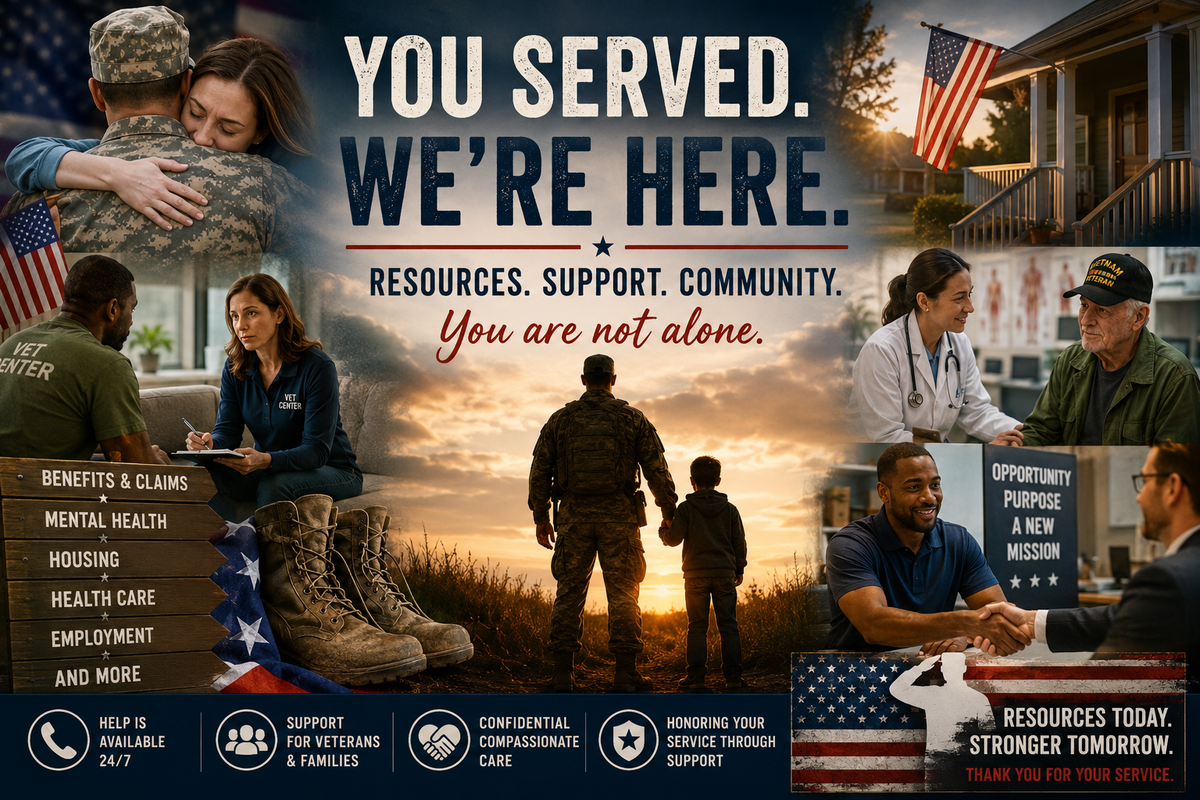
There are moments in life when knowing where to turn can make all the difference.
For veterans, those moments may involve a benefits claim, a difficult transition back into civilian life, a sudden housing crisis, an urgent mental health concern, a family member who needs support, or a question about records and benefits that seems impossible to answer.
The challenge is that help often exists—but finding it can be surprisingly difficult.
Government agencies, nonprofit organizations, veterans service organizations, health care systems, employment programs, legal clinics, and community resources all play a role in supporting veterans. Yet these resources are often spread across multiple websites, phone numbers, departments, and organizations. When someone is already under stress, simply knowing where to begin can feel overwhelming.
That is why a centralized resource directory can be so valuable.
The accompanying Veterans Resource Directory was created as a national starting point for veterans, military families, caregivers, and those who want to help connect them with meaningful support.
It is not intended to replace professional services, emergency assistance, or individualized advice. Rather, it serves as a practical roadmap—a place to begin.
If You Are in Crisis, Start Here
Before discussing benefits, housing, employment, or any other resource, one message deserves to come first:
A veteran in crisis does not have to face that moment alone.
The Veterans Crisis Line is available by dialing 988 and pressing 1, texting 838255, or using the online chat service. The service is free, confidential, and available 24 hours a day, seven days a week. Veterans do not need to be enrolled in VA health care to seek help.
This is an important point because many people hesitate to seek help under the assumption that they must already be enrolled in a particular program, have a diagnosis, or meet a complicated eligibility requirement.
In an immediate emergency, call 911.
For less immediate but still serious concerns, reaching out early can be an important act of strength. A crisis does not have to reach its most dangerous point before someone asks for assistance.
Understanding VA Benefits and Claims
For many veterans, benefits are an essential part of financial stability and long-term well-being.
Yet the benefits process can be complicated. Veterans may have questions about disability compensation, pensions, claims status, back pay, education benefits, or appeals. In some cases, a veteran may not know which benefits they may qualify for or how to begin the process.
The VA Benefits Hotline, listed in the directory, provides a starting point for questions regarding benefits and claims. Veterans can also seek assistance from accredited service officers through established veterans service organizations.
Organizations such as the Disabled American Veterans, Veterans of Foreign Wars, and The American Legion provide assistance with claims and appeals through accredited representatives. These service officers can help veterans better understand the process and, in many cases, assist with filing or appealing claims at no cost.
This is one of the most important reminders for veterans navigating the benefits system:
You do not necessarily have to navigate the process alone—and you should be cautious about paying someone for help that may be available at no cost through an accredited organization.
The directory also includes contact information for education-related benefits, including the GI Bill, as well as technical support for online benefits systems.
Mental Health Support Is Not Only for Emergencies
Mental health support is often discussed only in the context of crisis. But counseling and support can be valuable long before a person reaches an emergency point.
Veterans may struggle with readjustment, grief, trauma, relationship challenges, anxiety, depression, isolation, or the difficulty of finding a new sense of identity after military service.
The directory highlights the Vet Center system, which offers readjustment counseling and related support. The directory specifically notes that veterans do not need a diagnosis or enrollment in VA health care to seek Vet Center counseling.
That distinction matters.
Many people delay seeking help because they believe their situation is “not serious enough.” Others assume they must first prove that they have a specific condition.
Support does not have to wait until a person is in crisis.
The directory also includes the Women Veterans Call Center, recognizing that women veterans may have unique questions and experiences when navigating services and benefits.
Housing Instability Can Happen Quickly
Housing problems are not always the result of a single dramatic event.
A job loss, medical issue, family crisis, rising expenses, delayed benefits, or unexpected financial emergency can quickly place a veteran or military family in a precarious position.
When someone is facing homelessness or the possibility of losing housing, time matters.
The Veterans Resource Directory includes the National Call Center for Homeless Veterans, which provides access to information regarding emergency shelter, transitional housing, and programs such as HUD-VASH. It also identifies the National Coalition for Homeless Veterans as an additional resource.
The most important message for someone facing housing instability may be this:
Do not wait until you are sleeping in your car to ask for help.
If rent is becoming impossible, if eviction is approaching, or if a veteran is already without stable housing, reaching out as early as possible may create more options.
A resource directory cannot solve every housing problem. But it can help a person take the first step toward someone who may be able to help.
Health Care Resources for Veterans and Families
Health care questions can be confusing, particularly when a veteran is trying to understand eligibility, enrollment, community care, or coverage for family members.
The directory includes the VA Health Benefits line as a starting point for questions involving enrollment and eligibility.
It also identifies CHAMPVA, a separate program that may be relevant to eligible family members in qualifying circumstances.
Health care systems can involve complex eligibility rules. Because circumstances vary, veterans and families should contact the appropriate program directly to confirm their eligibility and understand their options.
The broader principle, however, is simple:
A veteran should not assume that a lack of knowledge means a lack of eligibility.
When in doubt, ask.
Finding Employment After Military Service
Transitioning into civilian employment can be both exciting and challenging.
Veterans often bring considerable experience in leadership, logistics, operations, technical work, management, communications, emergency response, and countless other fields. Yet translating military experience into civilian job descriptions can sometimes be difficult.
The directory includes VA Vocational Rehabilitation and Employment resources, now commonly associated with Veteran Readiness and Employment services, as well as American Job Centers.
These resources may provide career counseling, job training, education assistance, employment services, and other forms of support for eligible veterans. The directory also notes that veteran-specific employment representatives are available through state employment systems.
For veterans searching for work, the challenge is not always a lack of ability.
Sometimes, it is simply a matter of finding the right translation between what a person did in uniform and how that experience is understood in the civilian labor market.
Legal Problems Can Affect Every Other
Area of Life
Legal concerns can quickly become overwhelming.
A discharge status issue, benefits appeal, family legal matter, housing concern, debt problem, or other legal question may affect employment, finances, housing, and access to benefits.
The directory identifies Stateside Legal as a resource for finding free legal assistance for veterans and military families. It also encourages veterans to inquire about veteran discharge upgrade assistance and benefits appeal clinics through veterans legal services and local bar associations.
Legal assistance is particularly important because many veterans may not realize that free or reduced-cost legal services may be available based on their circumstances.
A legal question does not always require hiring a private attorney immediately. In some situations, a legal aid organization or veterans legal clinic may be able to provide guidance or connect a veteran with appropriate assistance.
Families and Caregivers Need Support, Too
Military service affects more than the individual who served.
Spouses, children, parents, caregivers, and other family members may also experience the consequences of service-related injuries, chronic conditions, transitions, financial stress, and emotional challenges.
Caregivers, in particular, can experience significant physical, emotional, and financial pressure while supporting a loved one.
The directory includes the VA Caregiver Support Line and Military OneSource, which provides access to counseling, financial coaching, and family resources.
Seeking support does not diminish the importance of the caregiver's role.
In fact, one of the most important lessons in caregiving is that a person cannot continue providing meaningful support indefinitely without receiving support themselves.
Families should not wait until everyone is exhausted before asking for help.
Records, Documents, and Financial Questions Matter
Some of the most frustrating challenges veterans encounter involve paperwork.
A missing DD-214 or difficulty locating military records can complicate benefits applications, employment, education, and other processes.
The directory includes the National Personnel Records Center as a resource for military records, including DD-214-related inquiries. It also includes the VA Debt Management Center for veterans who have questions related to certain VA debts and repayment matters.
The directory also points readers toward the National Resource Directory, a searchable database intended to connect veterans, service members, families, caregivers, and survivors with national and local resources.
The practical lesson is straightforward:
Keep important records. Ask questions. Save confirmation numbers. Follow up.
Government systems can be complicated, and documentation can matter greatly when trying to resolve a problem.
The Importance of Sharing Resources Before They Are Needed
A resource directory is most useful when people know about it before a crisis occurs.
Consider saving the PDF to your phone or computer. Share it with a veteran, family member, caregiver, community organization, church, nonprofit, social worker, employer, or anyone who may encounter veterans in need of assistance.
A person may not need a resource today.
But circumstances can change quickly.
A veteran who is employed today may face a housing emergency next month. A family member who appears to be coping may quietly be struggling. A benefits question that seems minor may become financially significant if left unresolved.
Having reliable information available can eliminate one unnecessary barrier: not knowing where to begin.
A Directory Is a Starting Point—Not the Final Answer
No resource directory can anticipate every situation.
Eligibility requirements change. Phone numbers and hours may change. Programs may have geographic restrictions, funding limitations, or other qualifications.
The accompanying directory appropriately advises readers to confirm information before wide distribution and reminds readers that the resource is not a substitute for emergency services.
That is an important disclaimer.
The purpose of a directory is not to promise that every person will qualify for every service. Its purpose is to make the first step easier.
And sometimes, the first step is the hardest one.
A Final Word to Veterans
If you are a veteran reading this and you are struggling, please understand that asking for help is not a failure.
You served.
You carried responsibilities that many people will never fully understand.
You may have spent years being the person others depended on. You may have learned to remain composed under extraordinary circumstances. You may have become accustomed to solving problems independently.
But there is no requirement that you solve every problem alone.
Whether you need assistance with benefits, housing, health care, employment, legal questions, records, family support, or mental health, there may be a resource available to help you begin.
And if you are in immediate danger or experiencing a mental health crisis, help is available now.
The most important step is often the first one: making the call, sending the message, opening the website, or telling someone, honestly, “I need help finding the right resource.”
That is not weakness.
That is a beginning.
Keep This Directory Accessible
The Veterans Resource Directory is designed to serve as a practical national reference guide for veterans, military families, caregivers, and community members.
Save it. Share it. Print it. Give it to someone who may need it.
Sometimes, the resource that changes a person's life is not a complicated program.
Sometimes, it is simply having the right phone number at the right moment.
Disclaimer
This Veterans Resource Directory is provided for general informational and community-resource purposes only. Inclusion of any organization, agency, telephone number, website, or program does not constitute an endorsement, recommendation, guarantee of services, or confirmation of eligibility.
Programs, eligibility requirements, telephone numbers, operating hours, websites, and available services may change. Veterans, service members, military families, caregivers, and other readers should verify current information directly with the appropriate agency or organization before relying on it.
This directory is not intended to provide legal, medical, mental health, financial, benefits, or other professional advice, and it does not create an attorney-client, doctor-patient, counselor-client, or other professional relationship. Individual eligibility and available services vary based on personal circumstances.
If you are experiencing an immediate emergency or are in immediate danger, call 911. If you or a veteran you know is experiencing a mental health crisis or needs immediate support, call 988 and press 1, text 838255, or use the Veterans Crisis Line chat service.
This resource was compiled for community outreach and informational purposes. Please confirm all contact information and program availability before distribution or use. We use AI, but we research our topics as well. Please, when calling for assistance, verify that you have the correct contact information, as this information may change from time to time.