Is AI the Ultimate Shortcut to a Six-Week Transformation?
Looking for a shortcut? Discover if an AI fitness coach can deliver a dramatic 6-week transformation. We review whether AI workout plans and automated diets actually optimize your results or if they're just high-tech gimmicks. Find out if AI is the future of fitness.

There is a growing conversation in fitness that cannot be ignored.
As artificial intelligence becomes more integrated into everyday life, it has naturally made its way into training programs, nutrition tracking, and recovery systems. For some, it represents a breakthrough. For others, it raises skepticism.
Can AI actually accelerate a six-week transformation—or is it simply another layer of noise in an already crowded industry?
The answer is not as simple as yes or no. It depends entirely on how it is used.
Because AI, on its own, does not create transformation.
It reveals structure. It removes guesswork. It accelerates feedback.
But it does not replace effort.
Where AI Actually Changes the Game
The individuals seeing the most significant results are not using AI as a novelty. They are using it as a system of refinement—something that supports decision-making rather than replaces it.
1. Smarter Training, Less Guesswork
Traditional fitness plans are often static. They assume the body will respond the same way every day, regardless of sleep, stress, or recovery.
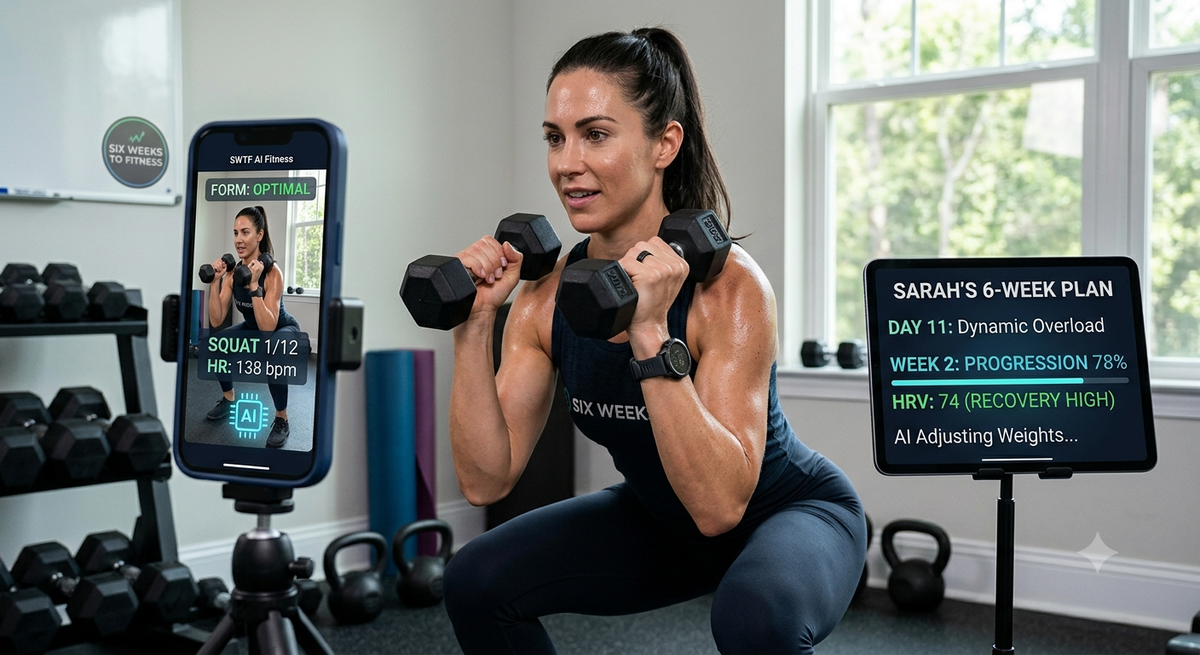
AI-driven training platforms take a different approach. They analyze performance trends and adjust recommendations in real time based on how the body is actually responding.
If a lift is consistently too easy, progression is introduced. If fatigue is evident, intensity is adjusted to prevent burnout.
This creates a more adaptive training environment—one that evolves alongside the individual instead of remaining fixed.
2. Recovery Becomes Part of the Plan
One of the most overlooked elements in any transformation is recovery.
Many people do not fall short because they lack effort. They fall short because they overextend early, ignore fatigue signals, and eventually hit a wall.
Wearable technology now tracks deeper recovery indicators such as heart rate variability, sleep quality, and readiness scores.
Instead of guessing when to push or pause, individuals receive data-informed cues that help them train more sustainably.
In many cases, progress improves not by doing more—but by recovering better.
3. Feedback Without Waiting
In traditional settings, form corrections or nutritional adjustments often require a coach, a check-in, or delayed feedback.
AI has introduced a more immediate layer of awareness. Camera-based tools can analyze movement patterns, count repetitions, and flag inconsistencies in real time.
Nutrition platforms can estimate intake through photos and provide ongoing adjustments based on goals and trends.
The value is not perfection. The value is immediacy.
The Missing Piece AI Cannot Replace
For all its capabilities, AI has a clear limitation.
It cannot choose discipline.
It cannot show up for the workout.
It cannot push through resistance when motivation is low.
It cannot make decisions in real time when effort is required.
It can only respond to what is given to it.
Which means the outcome still depends on the individual.
The Bottom Line
A six-week transformation is not created by technology alone.
AI can streamline the process, sharpen the data, and reduce inefficiencies that once slowed progress. It can make training more intelligent and recovery more intentional.
But it is still the individual who executes the work.
The most effective approach is not choosing between AI and discipline—it is combining both with clarity.
One provides structure.
The other provides consistency.
And when those two align, six weeks becomes far more powerful than most people expect.