Stop Overthinking Your Website: Why Building Online Has Never Been Easier

For years, launching a website felt like a project that required endless planning, technical expertise, and more patience than most entrepreneurs could spare. Many business owners spent months debating colors, layouts, fonts, and functionality before ever publishing a single page.
Today, that reality has changed dramatically.
Artificial intelligence has transformed website creation from a highly technical process into something far more accessible. What once required a team of designers, developers, and copywriters can now begin with a simple conversation and a clear vision.
The challenge facing many entrepreneurs is no longer how to build a website. It is deciding to stop overthinking it and get started.
The Rise of AI-Powered Website Creation
The evolution of artificial intelligence has reshaped countless industries, and web development is no exception. Modern AI-powered platforms can generate layouts, write copy, recommend images, and create responsive designs in a fraction of the time traditional development once required.
For small business owners, coaches, consultants, creators, and startups, this shift has significantly lowered the barriers to establishing a professional online presence.
The emphasis is no longer on technical skill alone. Increasingly, success depends on clarity—understanding who the website serves, what problem it solves, and what action visitors should take.
Choosing the Right Tool for the Job
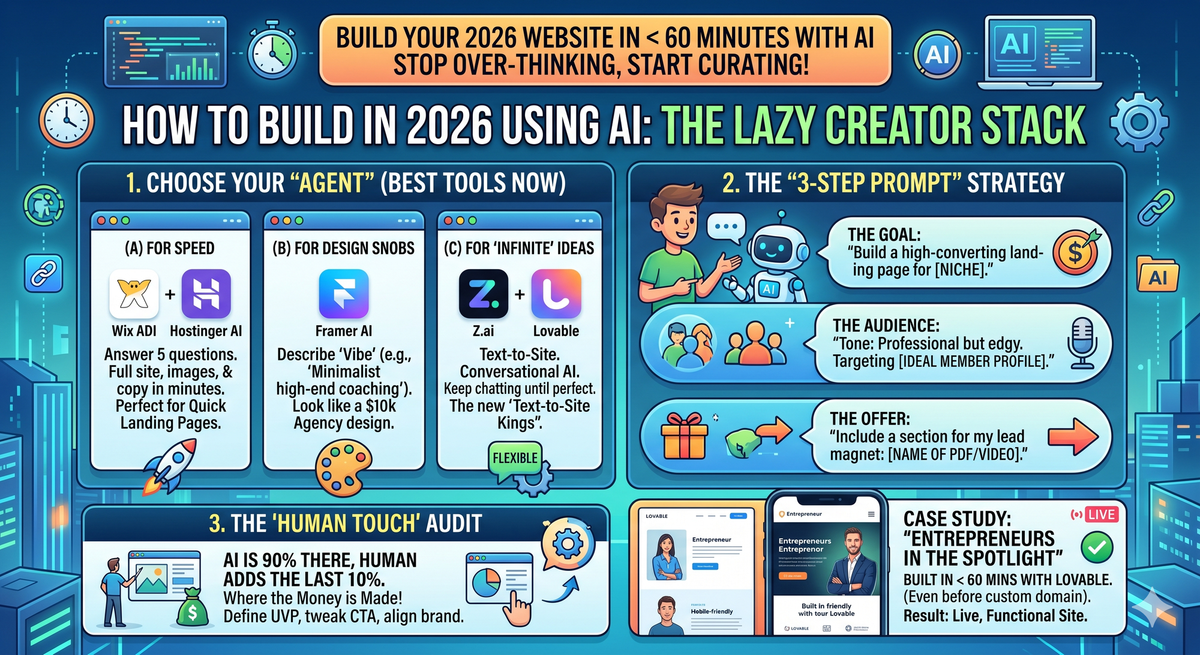
Today's AI website builders offer a variety of approaches depending on individual needs and preferences.
Some platforms focus on speed, helping users generate a simple landing page within minutes. Others prioritize design sophistication, allowing users to create highly customized experiences with minimal effort. A growing number of conversational builders enable users to refine their websites through an ongoing dialogue with the AI, making adjustments until the final product aligns with their vision.
While the tools may differ, the principle remains the same: technology is handling more of the heavy lifting than ever before.
Clarity Produces Better Results
One of the most common misconceptions about artificial intelligence is that it eliminates the need for strategic thinking. In reality, the quality of the outcome often depends on the quality of the input.
Successful website projects typically begin with three foundational questions:
- What is the primary goal of the website?
- Who is the intended audience?
- What action should visitors take after arriving?
When those answers are clearly defined, AI can generate content, layouts, and user experiences that are far more aligned with business objectives.
Without that clarity, even the most advanced technology can only guess.
Technology Can Build the Site. Only Humans Can Build Trust.
Artificial intelligence has become remarkably effective at creating websites, but it cannot fully replace human insight.
The strongest websites still reflect a clear understanding of customer needs, authentic brand messaging, and thoughtful communication. While AI can generate headlines, calls to action, and page structures, business owners remain responsible for ensuring that the message accurately reflects their values and expertise.
That final layer of refinement often determines whether a visitor simply browses a website or becomes a customer.
The Real Opportunity
Perhaps the most significant shift is not technological but psychological.
For many years, launching a website felt intimidating because the process appeared complicated and expensive. Today, the tools are more accessible, the learning curve is shorter, and the time required to move from idea to execution has been dramatically reduced.
The question is no longer whether someone has the technical ability to build a website.
The question is whether they are willing to move past perfectionism long enough to publish one.
The Bottom Line
In 2026, creating a professional online presence is more attainable than ever. Artificial intelligence has simplified many of the technical challenges that once prevented entrepreneurs and small businesses from getting started.
Yet technology alone is not the story.
The real advantage belongs to those who combine AI's efficiency with human creativity, strategic thinking, and a genuine understanding of the people they serve.
The tools are available. The barriers have been lowered.
Sometimes the hardest part is simply deciding that today is the day to begin.
Take a look at a website we built with AI.