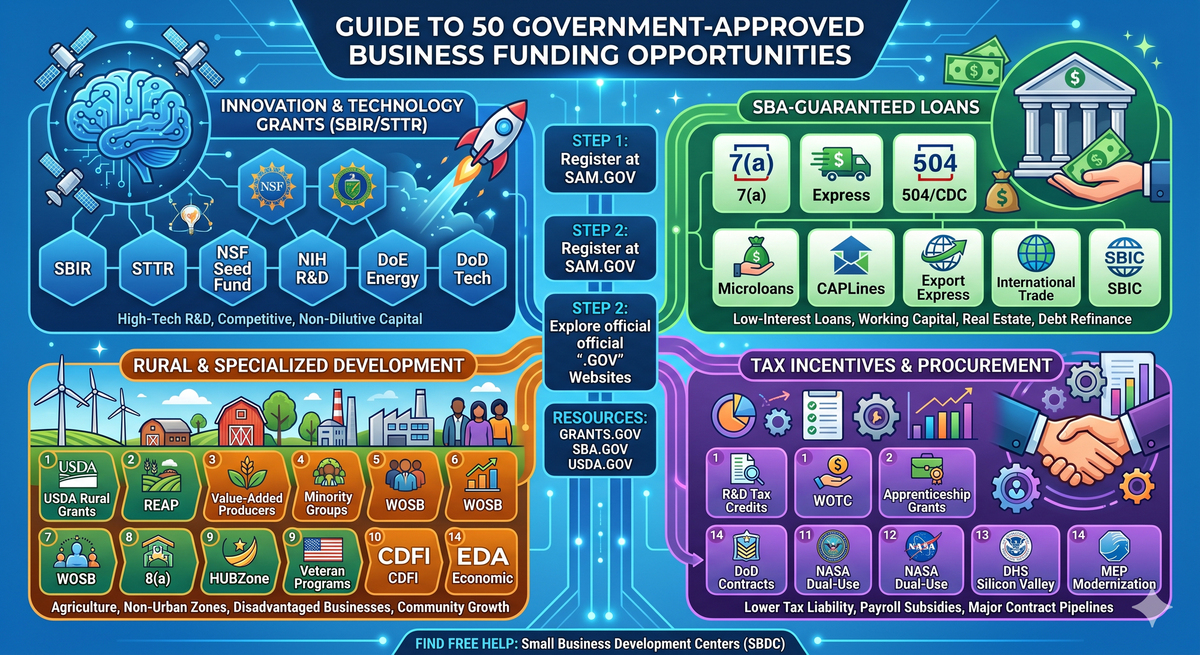
The Masterlist of Government-Approved Business Funding & Capital Programs
Unlock millions in government-backed capital. This masterlist compiles active, verified federal and state funding program, low-interest loan, and non-dilutive grant available to fuel your business growth in 2026. Stop wasting time searching—find your perfect funding match right here.
Finding reliable capital to scale your business shouldn't feel like a gamble or an endless search through sketchy online forums. Every year, billions of dollars are quietly injected into the economy through official, government-approved funding pipelines—ranging from equity-free tech grants and low-interest guaranteed loans to heavy tax credits and exclusive federal procurement programs.
If you know exactly where to look, what to look for, and how to safely verify the source, you can stop guessing and start leveraging the ultimate financial toolkit. This comprehensive guide uncovers 50 legitimate, government-backed capital opportunities designed to help you launch, protect, and grow your enterprise.
Federal R&D & Innovation Grants
- SBIR (Small Business Innovation Research)
Competitive, non-dilutive federal funding for small businesses developing innovative technologies. Often used for early-stage R&D and commercial proof-of-concept work. - STTR (Small Business Technology Transfer)
Federal funding that requires collaboration between a small business and a research institution. Designed to move scientific research toward commercial application. - NSF Seed Fund
NSF’s program supporting deep-tech startups turning scientific discoveries into market-ready products. Helps founders advance high-risk, high-impact innovation. - NIH R&D Grants
NIH small business funding for biomedical and health-related technologies.
Supports startups developing tools, devices, diagnostics, and health innovations. - DoD SBIR/STTR Program
Department of Defense funding for technologies with military and commercial potential. Often supports dual-use innovation across defense and civilian markets. - DoE Energy Efficiency Grants
DOE funding for clean energy, energy efficiency, grid modernization, and carbon reduction technologies. A fit for startups working on advanced energy solutions.
SBA-Guaranteed Loan Programs
- SBA 7(a) Loans
The SBA’s flagship loan program for small businesses. Can be used for working capital, equipment, refinancing, real estate, and general business needs. - SBA Express Loans
A faster-processing version of SBA financing with streamlined approval.
Useful for businesses needing quicker access to capital. - SBA 504 / CDC Loans
Long-term, fixed-rate financing for major fixed assets like real estate and large equipment. Commonly used by businesses expanding facilities or making capital investments. - SBA Microloans
Smaller loans offered through nonprofit intermediaries, often for startups and early-stage firms. Can help with working capital, inventory, supplies, and equipment. - SBA CAPLines
SBA-backed revolving lines of credit for short-term or seasonal working capital needs. Designed to help businesses manage cyclical cash flow. - SBA Export Express
Fast-tracked SBA financing for businesses entering or expanding in international markets. Useful for export-related working capital and trade growth.
Agriculture & Rural Development Funding
- USDA Rural Business Development Grants
USDA grants that support rural business growth, technical assistance, and economic development. Often used for training, planning, and small-scale infrastructure improvements. - REAP (Rural Energy for America Program)
USDA grants and loan guarantees for renewable energy systems and energy efficiency upgrades. Helps agricultural producers and rural small businesses reduce energy costs. - Value-Added Producer Grants (VAPG)
Supports agricultural producers adding value to raw commodities through processing or marketing. Helps farmers expand revenue and reach new markets. - USDA Rural Microentrepreneur Assistance Program
Provides loan and training support through microenterprise development organizations. Helps very small rural businesses access capital and business assistance.
Minority, Women, & Disadvantaged Business Programs
- SBA 8(a) Business Development Program
A business development program for socially and economically disadvantaged small businesses. Can help firms compete for federal contracts and long-term growth opportunities. - WOSB Federal Contracting Program
Supports women-owned small businesses seeking access to federal contracting opportunities. Helps level the playing field in government procurement. - SDVOSB (Service-Disabled Veteran-Owned Business)
Federal contracting program for businesses owned by service-disabled veterans. Provides access to set-aside and sole-source opportunities. - HUBZone Program
Gives small businesses operating in historically underutilized business zones preferential access to federal contracts. Supports economic development in underserved communities. - ORR Microenterprise Development Program
Supports refugees in starting, expanding, or maintaining small businesses.
Designed to promote economic self-sufficiency and financial independence.
State, Regional, & Disaster Support
- SSBCI (State Small Business Credit Initiative)
Treasury program that sends capital to states to expand lending and investment for small businesses. Helps unlock local loan and venture programs. - SBA Disaster Assistance Loans
Low-interest loans for businesses and homeowners recovering from declared disasters. Can support physical damage repair or economic injury recovery. - STEP (State Trade Expansion Program)
Grants to states that help small businesses pursue export opportunities.
Can offset costs tied to international marketing and trade expansion. - CDFI Fund
Treasury-backed fund that supports community lenders serving low-income and underserved areas. Helps expand access to capital where traditional financing is limited. - EDA Economic Adjustment Assistance
Economic Development Administration support for communities facing economic disruption or decline. Often used for regional revitalization, infrastructure, and job creation. - America's SBDC Network
A nationwide network of Small Business Development Centers offering free business counseling and support. Helps entrepreneurs with planning, financing, growth, and operations. - HUD Community Development Block Grants
Federal funds distributed to local governments for community development projects. Often used to support local business districts, storefront improvements, and neighborhood revitalization.
Specialized Technical & Manufacturing Funding
- MEP National Network Awards
Manufacturing Extension Partnership support for small and midsize manufacturers. Focuses on efficiency, automation, modernization, and growth. - EPA Environmental Justice Grants
Funding for projects addressing environmental and public health challenges in affected communities. Often supports local advocacy, remediation, and community-based solutions. - DOT University Transportation Centers (UTC)
Federal research grants supporting transportation innovation through university partnerships. Useful for smart mobility, transit, logistics, and infrastructure research. - Department of Education (ED) SBIR
SBIR funding focused on educational technology and learning innovation.
Supports startups developing tools for schools, students, and educators.
Employee Retention & Job Creation Incentives
- Work Opportunity Tax Credit (WOTC)
A federal tax credit for employers who hire individuals from target groups facing barriers to employment. Helps reduce labor costs while supporting workforce inclusion. - Federal R&D Tax Credit
A tax incentive for businesses conducting qualified research activities in the U.S. Can help offset costs tied to innovation and product development. - Apprenticeship Building America (ABA) Grants
Grants that help employers build and expand registered apprenticeship programs. Supports workforce training and long-term talent development. - WIOA Incumbent Worker Training
Workforce funding that helps employers upskill current workers.
Often administered through state and local workforce systems.
Defense, Security, & Aerospace Procurement
- APFIT (Accelerate the Procurement and Fielding of Innovative Technologies)
A Department of Defense initiative that helps move promising technologies into production and fielding. Designed to bridge the gap between prototype and deployment. - DHS Silicon Valley Innovation Program (SVIP)
DHS program supporting startups developing technologies for homeland security applications. Focuses on areas like borders, airports, and cybersecurity. - NSA Cryptologic Venture Opportunities
NSA-related opportunities for companies building advanced data security and encryption technologies. Best suited for highly specialized defense and cybersecurity innovation.
Alternative SBA & Federal Lending Structures
- SBIC Program (Small Business Investment Companies)
SBA program that partners with private investment funds to support small business growth. Helps channel private capital into high-growth companies. - SBA 7(a) International Trade Loans
Financing for businesses engaged in international trade or affected by foreign competition. Can be used to support export growth and related expansion needs. - VA Veteran Readiness and Employment (VR&E)
VA program offering support for veterans with service-connected disabilities.
Can help cover training, equipment, and business startup needs in eligible cases.
Local Economic & Community Development
- New Markets Tax Credit (NMTC)
Federal tax credit program encouraging private investment in low-income communities. Often used to support community facilities, operating businesses, and redevelopment projects. - Appalachian Regional Commission (ARC) Grants
Economic development grants for projects in the Appalachian region.
Supports business growth, infrastructure, workforce, and community development. - Delta Regional Authority (DRA) Funding
Federal support for economic development and job creation in the Mississippi Delta region. Often focused on infrastructure, workforce, and business investment.

Here is a structured, scannable overview of the programs highlighted in the masterlist, grouped by their core focus areas:
1. Innovation & Deep Tech (R&D Grants)
These are primarily non-dilutive (equity-free) grants for high-risk, high-impact technical development.
- SBIR & STTR Programs: The major federal pipelines for small business tech innovation. STTR requires partnership with a research institution.
- Agency-Specific Seeds: Targeted funds from the NSF (deep tech), NIH (biomedical/health), DoD (defense/civilian dual-use), DoE (clean energy/efficiency), and the Department of Education (EdTech).
2. SBA-Guaranteed Loans
These traditional and fast-tracked loans are backed by the Small Business Administration, reducing risk for lenders and securing better rates for you.
- SBA 7(a): The flagship program for general working capital, equipment, and refinancing.
- SBA Express: A streamlined version of the 7(a) for quicker turnaround times.
- SBA 504 / CDC: Specifically designed for major fixed assets like real estate or massive machinery.
- SBA Microloans & CAPLines: Microloans focus on startups/early-stage firms (under $50k), while CAPLines act as revolving short-term credit lines.
- Export Express & International Trade Loans: Tailored for entering global markets or handling foreign competition.
3. Agriculture & Rural Enterprise
If your business operates in a rural area or handles agricultural commodities, the USDA has its own funding suite:
- USDA Rural Business Development Grants: Funding for infrastructure, training, and small-scale community business growth.
- REAP (Rural Energy for America Program): Grants and guaranteed loans specifically to fund renewable energy setups or efficiency upgrades.
- Value-Added Producer Grants (VAPG): Capital for farmers/producers expanding into processing or marketing their raw goods.
4. Diversity & Disadvantaged Enterprise Programs
These programs focus heavily on preferential access to highly lucrative federal procurement contracts:
- SBA 8(a) Business Development: Long-term assistance for socially and economically disadvantaged firms.
- WOSB & SDVOSB: Sole-source and set-aside contract opportunities for Women-Owned and Service-Disabled Veteran-Owned Small Businesses.
- HUBZone: Preferences for businesses located in historically underutilized urban or rural zones.
- ORR Microenterprise Development: Targeted startup support for refugees.
5. Regional, State, & Community Reinvestment
Funding localized through states, communities, or neighborhood development funds:
- SSBCI (State Small Business Credit Initiative): Federal capital funneled directly to states to expand local lending and venture capital.
- CDFI Fund & HUD Block Grants: Support targeted at underserved or low-income business districts.
- SBA Disaster Assistance: Low-interest relief loans to recover from declared physical or economic disasters.
- Regional Commissions (ARC & DRA): Targeted funding specifically for businesses in the Appalachian and Mississippi Delta regions.
6. Workforce Incentives & Tax Credits
Ways to claw back capital through hiring practices or innovation:
- Work Opportunity Tax Credit (WOTC): Federal tax credits for hiring employees from target demographic groups facing employment barriers.
- Federal R&D Tax Credit: Tax offsets for qualified research and product experimentation conducted inside the U.S.
- Workforce Training (ABA & WIOA): Grants to support registered apprenticeships or upskilling your current workforce.
7. Specialized Manufacturing & Defense Procurement
- MEP National Network: Support and funding targeting modernizing small to midsize American manufacturers.
- DHS Silicon Valley Innovation (SVIP) & APFIT: Rapid pipelines to move tech prototypes straight into production for Homeland Security or Defense fielding.

Government-Approved Venture Capital Frameworks
Unlike traditional equity-free grants, the federal government does not issue venture capital checks directly to founders. Instead, federal agencies license, regulate, and co-fund specific private venture capital funds and state authorities. Entrepreneurs seeking high-growth equity or venture debt can pitch these government-backed entities directly.
Small Business Investment Companies (SBIC)
Licensed and regulated by the U.S. Small Business Administration (SBA), the SBIC network is one of the largest government-approved venture ecosystems in the world. The SBA channels low-cost, government-backed capital to private investment managers to deploy into qualified U.S. small businesses.
- National Registry: Access the complete, active database of over 300 licensed funds directly through the official SBA SBIC Directory.
- Notable Active SBIC Funds:
- Multiplier Capital: Heavily focused on late-stage venture debt and technology expansions.
- AE Ventures: Tailored specifically to venture-stage investing across aerospace, national security, and defense tech.
- Champlain Capital Partners: Focuses on growth equity investments for expanding, mid-market enterprises.
- Corbel Capital Partners: Provides highly flexible, structured debt and equity solutions for growth-phase companies.
State Small Business Credit Initiative (SSBCI)
Administered under the U.S. Department of the Treasury, the SSBCI program allocates nearly $10 billion to states, territories, and Tribal governments to expand access to localized equity, venture capital, and loan participation programs. Each jurisdiction selects its own approved fund managers.
- National Registry: Locate your state’s point of contact and available equity programs via the Treasury's List of SSBCI Capital Programs and Contacts.
- Notable State-Sanctioned Venture Funds:
- Connecticut Innovations: The state of Connecticut's official venture capital arm, managing millions for early-stage tech and life sciences startups.
- Innovate Alabama: A state-managed innovation corporation deploying dedicated equity co-investment programs to regional businesses.
- Colorado Venture Capital Authority (VCA): A state-backed authority providing critical venture equity to high-growth, Colorado-based operations.
💻 A note on applying: For any program hosted on a general federal site likeGrants.govorSBA.gov, your first operational step will be to register your business on SAM.gov (System for Award Management). This generates your Unique Entity ID (UEI), which is the standard identification number the government uses to send you funds.
Disclaimer & AI Disclosure
General Information Only: The information provided in this guide is for educational and informational purposes only and does not constitute formal financial, legal, or professional business advice. Government programs, eligibility requirements, funding caps, and application windows are subject to change by their respective federal, state, or local agencies without notice. Readers are strongly encouraged to verify all requirements directly on official .gov websites or consult with a certified financial advisor or a local Small Business Development Center (SBDC) counselor before applying for any financial program.
Disclaimer – Government Website Updates
Due to recent updates and changes across federal agencies, some linked government websites or pages may no longer be available, may have been moved, or may have been archived. Links on this site are provided as a resource and are not guaranteed to remain current or accessible.
If a government page does not load or content is missing, please use the official agency homepage or contact the agency directly for updated information. We strive to keep our resource list accurate and up to date, but we do not control or maintain government websites and cannot guarantee that all external links will remain active.
AI Disclosure: This guide is AI-generated but human-engineered. While artificial intelligence was utilized to help research, aggregate, and organize this extensive volume of federal funding data, human strategy and oversight were applied to engineer the structure, verify the safety of the official portals, and ensure the information remains actionable. Because government frameworks shift, the user assumes full responsibility for conducting independent due diligence and verifying the authenticity of any program or funding entity before sharing sensitive business or personal information.